Quartz Countertop Fabrication: From Slab to Installed
You pick a quartz slab in a showroom, and a few weeks later a finished countertop appears in your kitchen. What happens in between is quartz countertop fabrication — the craft of turning a large, heavy slab into a precisely cut, edged and polished surface that fits your room to the fraction of an inch.
Understanding the journey from slab to installed helps Chicago homeowners ask better questions, compare quotes fairly and avoid surprises. This guide walks through the general stages of fabrication, what affects the result, and how to prepare your kitchen. Pricing is individual and depends on scope, so we do not quote numbers here — but you will know exactly what to ask about.
What Is Quartz, and Why Does Fabrication Matter?
Engineered quartz is made mostly from ground natural quartz combined with resins and pigments, then pressed into dense slabs. The result is a non-porous, consistent surface that resists staining and does not need the periodic sealing that many natural stones do. If you are still deciding between materials, our comparison of quartz vs. granite vs. marble countertops is a good place to start.
But even the best slab is only as good as its fabrication. Accurate measuring, clean cuts, well-placed seams and carefully finished edges are what separate a countertop that looks custom from one that merely looks installed. That is why people who are researching quartz fabrication in Chicago are often really asking about craftsmanship, not just material.
Step 1: Choosing and Reserving the Slab
Fabrication begins before any cutting. Quartz comes in a wide range of colors, from clean whites and soft grays to veined looks that mimic marble. A few things are worth considering when you choose:
- Look at the full slab. Small samples cannot show how veining or movement flows across a large surface.
- Check light. View the slab in daylight and under warm evening lighting, since Chicago kitchens often have limited natural light in winter.
- Plan for layout. Large islands or long runs may need careful slab planning so patterns look continuous.
- Confirm the finish. Polished is most common, while honed or textured finishes give a softer, matte look.
Step 2: Templating and Measuring
Accurate measurements are the foundation of a good countertop. In general, templating takes place once the base cabinets are installed and secure, because the template must reflect the real room — including walls that are not perfectly straight, which is common in older Chicago buildings.
This is also when decisions are confirmed: sink and faucet locations, cooktop cutouts, overhangs for seating, backsplash height and edge profile. Having your sink and appliance specifications on hand avoids delays, since cutout sizes depend on the exact models.
Step 3: Cutting, Shaping and Finishing
With the template as a guide, the slab is laid out to make the best use of its pattern and cut to shape using specialized equipment. Cutouts for the sink and cooktop are made, corners are rounded to the chosen radius, and edges are shaped and polished. Common edge profiles include:
- Eased or square edge — clean, modern and minimal.
- Beveled edge — a slight angle that softens the look.
- Bullnose or half-bullnose — rounded and family-friendly.
- Mitered or built-up edge — creates a thicker, more substantial appearance.
Seams are planned where they are least noticeable and structurally sensible, often away from the sink and cooktop. Quartz is dense and heavy, so how a countertop is divided also affects how it can be carried through doorways, hallways and stairwells — a real consideration in vintage Chicago two-flats and walk-up buildings.
Step 4: Delivery and Installation
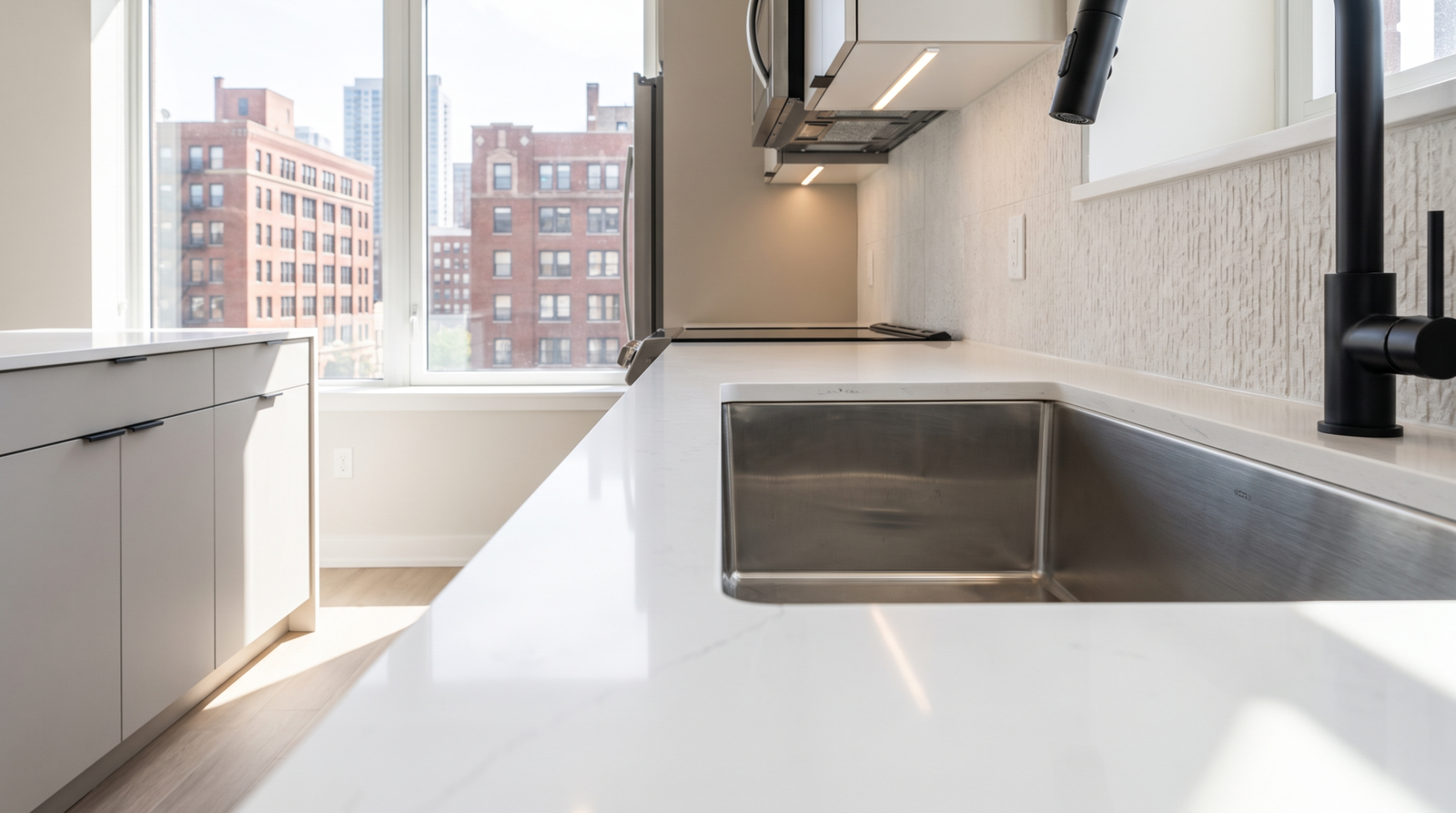
Once fabricated, the countertop is delivered and set on the cabinets. Pieces are leveled, seams are joined and color-matched, and the surface is secured. Then the final details come together: sink installation, backsplash, and any plumbing or appliance reconnection. For many kitchen projects, countertops are one stage within a larger plan, so coordinating timing with cabinets, tile and plumbing keeps everything moving. If you are planning a full update, see our overview of kitchen design and remodeling.
How to Prepare Your Kitchen
- Finalize cabinets first. Countertop measurements depend on cabinets being installed and level.
- Choose sink and cooktop early. Cutouts are specific to the model.
- Clear access. Make sure doorways, stairs and parking are accessible for a heavy delivery.
- Clear the work area. Empty cabinets and counters so work can happen smoothly.
- Plan for downtime. Your kitchen will be limited while old counters come out and new ones go in.
FAQ
How long does quartz countertop fabrication take?
Timing varies with slab availability, the complexity of the layout and the fabricator’s schedule. Ask for a realistic timeline after templating, since that is when the details are confirmed.
Will I see seams in my quartz countertop?
Seams are often unavoidable on longer runs or L-shaped layouts, but good planning and careful installation make them subtle. Where they fall depends on the slab size and your kitchen layout.
Does quartz need to be sealed?
Engineered quartz is non-porous, so it generally does not need sealing the way many natural stones do. Always follow the manufacturer’s care recommendations, and avoid exposing it to extreme heat.
Can I keep my existing sink?
Sometimes, but cutouts are made for specific sinks, so it is important to share the model details at templating. An undermount sink is a popular option with quartz.
How much does quartz countertop fabrication cost?
There is no single answer. Pricing is individual and depends on the slab, the amount of countertop, edge profiles, cutouts and installation details. The best way to know is to request a personalized quote.
Get a Free Quote for Your Countertops
Great quartz countertops come from good planning, precise templating and careful finishing. PM Tile works with Chicago homeowners on kitchens, bathrooms, tile and stone. Every project is different, so request a free, personalized quote and let’s talk about your countertops.